Update: ‘To be produced in Wolfsburg, Germany’ section added.
The introduction of the ID.3 doesn’t signal the end for the VW Golf. Instead, as part of Volkswagen’s electrification drive, the Golf is set to receive its own electric powertrain when it shifts to the next generation. Here’s everything that we’ve learned about the future VW Golf Electric.
VW bosses confirm e-Golf return
Back in December 2022, Oliver Blume, the CEO of Volkswagen Group, hinted at the introduction of an all-new VW Golf EV. He said:
The Volkswagen brand is currently examining how it can take icons such as the Golf or the Tiguan into the electric future.
Oliver Blume, CEO, Volkswagen Group (Extraordinary General Meeting 2022 on December 16, 2022)
In January 2023, Thomas Schäfer, CEO, Volkswagen, told Auto Bild Spain that the VW Golf will ditch the internal combustion engine for a fully-electric powertrain when moving to its ninth generation. When asked about the current car’s future, Schäfer said, “We will update the Golf now in 2024, it will be a review of the new model.” In early September 2023, Schäfer reaffirmed that the next-gen Golf will be a pure-electric car, Autocar said in a report on September 7, 2023.
At the 2022 Los Angeles Auto Show, Schäfer hinted to Autocar that the next-gen VW Golf EV might be dubbed the VW ID. Golf with a GTI variant. He remarked that ditching names like Golf and GTI “would be crazy” and while Volkswagen aims to use the ID. naming for EVs, “iconic models will carry a name.”
Design & Features
Andreas Mindt, who joined Volkswagen Passenger Cars as its Head of Design on February 1, 2023, will likely oversee the design of the next-gen VW Golf EV. Mindt developed a new brand design language for Bentley before he moved to Volkswagen Passenger Cars, and here, too, he is likely to come up with a new visual philosophy, which we should see on the VW ID. Golf.
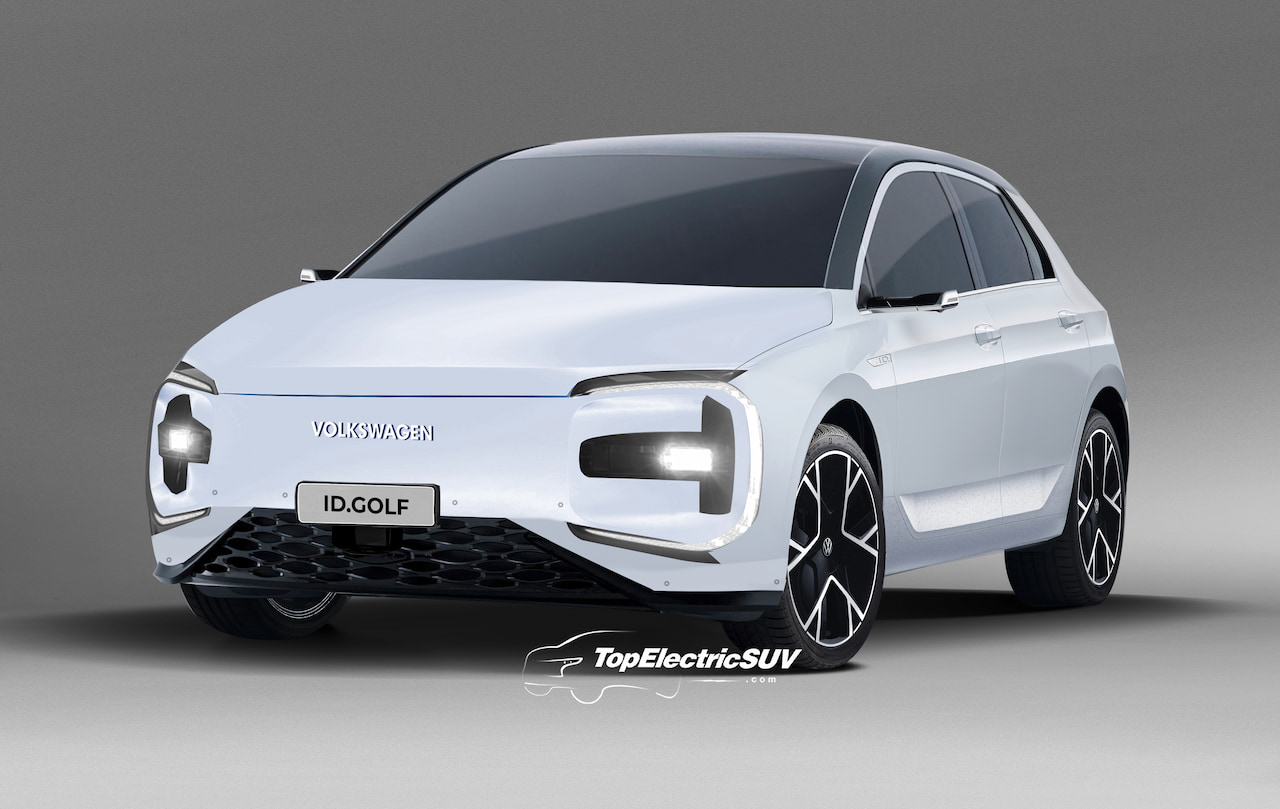
The next-gen VW Golf could look strikingly different from the eighth-gen model. The new pure-electric Golf should have a clean and smart exterior, with a new concept for the lights and grille, shorter overhangs, and almost fully covered wheels.
The interior will likely be a big departure, although more due to the layout than the design theme. Volkswagen has heavily digitalized the Golf’s interior, and if anything, it should dial back. For example, touch sliders and touch-operated steering controls have failed to impress customers. The company will offer a rotary controller instead of touch sliders, as per the Autocar report. We’re hoping it’ll replace the steering controls, too.
The next-gen Golf will likely be more practical with its sleek dashboard and flat floor. As there’s no transmission tunnel, VW designers may use the free space between the front seats to offer a movable center console. Another interesting feature could be reclining rear seats.
To be based on the SSP architecture
In an interview with Automobilwoche, released online on April 2, 2023, Schäfer said that Volkswagen won’t launch an all-new electric Golf until it becomes possible to do so with the signature elements, such as a flatter roof compared to the ID.3. When probed further that if it would arrive directly based on the Scalable Systems Platform (SSP), anticipated in 2028, the brand boss said: “Exactly. Before that, we don’t do electric Golf.”
A budget model like the ID. Golf might not receive top-tier features to keep it cost-effective. A 300-mile WLTP range should satisfy most users, while space, simplicity, and affordability could be the points of interest, surpassing the ID.3 in these aspects.
SSP is Volkswagen Group’s future mechatronics platform, the successor of MQB, MSB, MLB, as well as MEB and PPE. There’ll be multiple versions of this platform, though. For example, SSP Sport will underpin various Porsche models. Mass-market brands like Volkswagen and Skoda will go for a basic version. The ID. Golf will benefit from Volkswagen Group’s future in-house software platform E³ 2.0 as well, which the company plans to roll out across brands with the SSP.
We have defined the technology profiles for our Scalable Systems Platform – a scalable modular system that we will roll out at all brands by the end of the decade. To that end, we have allocated power ranges to the brand groups so that there will be no more overlaps in future. That allows us to leverage synergies even more effectively going forward.
Oliver Blume, CEO, Volkswagen Group (Extraordinary General Meeting on December 16, 2022)
Gains GTI & R variants
At IAA 2023, Volkswagen unveiled the ID. GTI Concept, a hot hatch based on the ID. 2all concept show car, and confirmed the launch of GTI-badged electric cars in the future. “GTI has a future,” Schäfer said commenting on the world premiere of the pure-electric GTI model. “Production has already been decided as part of our electric offensive,” he added. The letter “I” in the GTI name stood for injection until now, but in the electric era, it will represent intelligence.
While the Polo-sized ID.2 could be the first EV with a GTI variant, the ID. Golf could be the first EV to receive the full-blown R variant. The ID. Golf R could have a twin-motor powertrain, an AWD drivetrain layout, and a sub-4-second 0-62 mph acceleration time. Schäfer has indicated that Volkswagen will launch an electric R model. It would be “crazy” to let these (GTI and R) badges “die and slip away,” the company chief told Autocar. He also said that an electric R model will need the greater power and potential of the SSP to become a reality.
Release date is about 5 years away
According to the Autocar report dated September 7, 2023, the next-gen VW Golf, which will be a pure electric car as standard, will be launched in 2028. The redesigned Golf will be the first Volkswagen underpinned by the SSP.
To be produced in Wolfsburg, Germany
In an announcement on September 29, 2023, Volkswagen confirmed that the all-electric successor to the VW Golf will be manufactured in Wolfsburg, Germany, which currently makes several ID. series models.
The high-volume VW icon Golf is also to be led into the electric future here on an SSP basis.
Volkswagen Passenger Cars, in an announcement on September 29, 2023
On the “fight” for a new VW Golf Electric
December 2022 wasn’t the first time we heard of a new VW Golf Electric. On February 21, 2022, YouTube channel Autogefühl posted an interaction with Klaus Zyciora, the former Head of Design at Volkswagen Group, where he signaled the comeback of the VW Golf EV (VW e-Golf):
I will also fight for an electric, full-electric reincarnation of the Golf. Once the combustion age comes to an end, there need to be a VW Golf full electric.
Klaus Zyciora, former Head of Design, Volkswagen Group (Discussion with Autogefühl’s Thomas Majchrzak on February 21, 2022)
Zyciora, a high-profile name in the field of automotive design, is behind the sixth, seventh, and eighth generations of the VW Golf, including the VW e-Golf that broke cover at IAA 2013 and was sold between 2014 and 2021. While he has left Volkswagen, he must be pleased that the popular Golf will be all-electric in its upcoming version!
VW e-Golf in the U.S.
The VW e-Golf went on sale in the U.S. as a 2015 model in November 2014, starting at USD 35,445. Initially, the all-electric compact hatchback delivered an extremely low EPA-est. range of 83 miles from its puny 24.2 kWh battery pack.

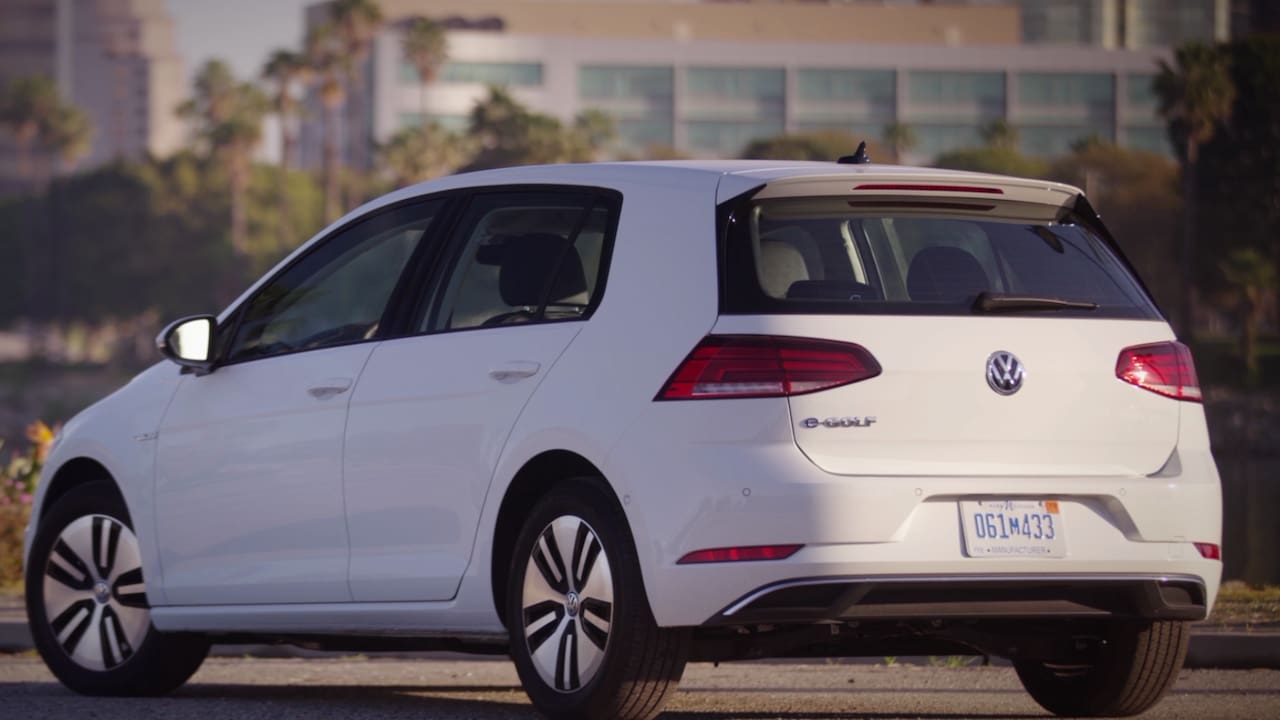
With facelift for the model year 2017, the EPA-est. range increased by 50% to 125 miles, thanks to the 35.8 kWh battery. It was considerably more affordable, too, with a starting price of USD 30,495. 2019 was the final model year for the electric hatchback. While it’s very early to speculate about the return of the e-Golf to the U.S. market, we’re sure VW would be studying the sales evolution of the new MINI Electric, the Fiat 500e, and the Fisker Pear, before deciding on its potential return.
TopElectricSUV says
The VW Golf was originally designed as an affordable car for everyday use. From commuting to running errands, it was designed to be a versatile vehicle. As Volkswagen transitions the Golf into an electric vehicle, the big challenge for the German designers and engineers will be to maintain this core essence of practicality and affordability. The degree to which the Golf EV succeeds in this regard remains to be seen.
Featured Image: TopElectricSUV’s rendering of a futuristic VW e-Golf

An automobile engineer by training, I’ve analyzed the global car market since 2005, with a keen focus on EVs since 2008. My journey in online automotive publishing spans 16 years, during which I have reviewed cutting-edge automotive technologies and interviewed leading CEOs and vehicle developers from around the world.